
Assignment: Design Cher's Digital Closet using conceptual data models
- Feb 24
- 2 min read
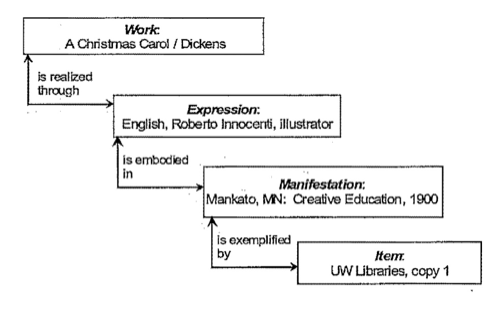
The Functional Requirements for Bibliographic Records was a fascinating look into a conceptual data model with which I had little prior familiarity. With software, I feel it is easy to get stuck in the headspace of a specific use case, and build practical data models only for what’s needed for the function of the application. When reading about FRBR, I realized that starting at the conceptual level could help “future proof” a data model.
I tried to apply this concept at a small scale with my Digital Closet data model for personal decision making. Applications and their users often defy their original use cases as new features are added and new use cases are realized. For something like a closet organizer, I thought first of the primary use case– someone who wants an app to help them get dressed with the clothes they have in their closet. If I were to just design a simple “item only” data model with different designers, colors, and brands as “attributes,” this basic model could fulfill a basic “digital closet” need.
What happens if there’s a missing piece in someone’s wardrobe– something out there that could help complete a certain look? Or what if a favorite and well-loved item gets lost, and the user wants to seek an exact replacement? What if someone discovers a favorite designer and wants to know more about what that designer has to offer? In imagining these scenarios, the “item only” model becomes insufficient for these connected uses.

By separating the “clothing product” (manifestation) and the “clothing item” (item), things like duplicates, different sizes, and other item-level data can be tracked separately from the SKU-level, bringing additional flexibility to users. By connecting “vibe” to multiple entities, cross-brand/cross-product searching could become easier. Separating the “brand” (company) from the “designer” (person) might help better track preferences and find specific pieces.
The introduction of "vibe" allows even further user personalization of digital closets. I imagine that database administrators could start the "vibe" categorization of different records to help give users a starting place, but users themselves could also add tags and descriptions, building a "curated vibe folksonomy" alongside administrators who help consolidate and differentiate tags as needed, as described in Bullard's Curated Folksonomies article. I imagine that such a folksonomy could help users understand their own personal items in new contexts introduced by the "vibe" tags.
Resources
Bullard, J. (2018). Curated Folksonomies: Three Implementations of Structure through Human Judgment. KNOWLEDGE ORGANIZATION, 45(8), 643–652. https://doi.org/10.5771/0943-7444-2018-8-643
Carlyle, A. (2006). Understanding FRBR As a Conceptual Model. Library Resources & Technical Services, 50(4), 264–273. https://doi.org/10.5860/lrts.50n4.264
Comments